
Google's Merchant Center architecture offers a modular, multi-tenant framework for ecommerce integrations. By integrating as a service provider, your platform manages Merchant Center capabilities centrally on behalf of your merchants, allowing them to connect their existing Merchant Center accounts and enable direct, native buying on Google's buy-enabled surfaces, including Search, Gemini, and AI Mode.
Introduction
The Merchant Center service provider integration with Universal Commerce Protocol (UCP) is available as an early pilot program. As an early integration partner, your platform helps shape the future of direct, native buying across Google Search, Gemini, and AI Mode.
To protect merchant data and ensure reliable multi-tenant operations at scale, onboarding follows a structured path—establishing enterprise-grade isolation, cryptographic profile signing, and secure server-to-server authentication. Completing this foundational setup is a one-time investment: once your platform is validated, you can onboard individual merchants in just a few clicks without per-merchant development.
Throughout your integration, you are never debugging alone. Google's technical partner engineering team supports you directly through every milestone—from isolated sandbox testing to joint validation—ensuring a smooth, high-confidence production launch.
For example, when you offer the UCP checkout service, merchants authorize your platform to manage UCP checkout on their behalf through a secure, Google-hosted account linking dialog in your portal. Approving the service proposal establishes the link between the merchant's account and your platform. Once linked, your backend coordinates transaction processing server-to-server with Google's buy-enabled surfaces.
Architecture and integration flow
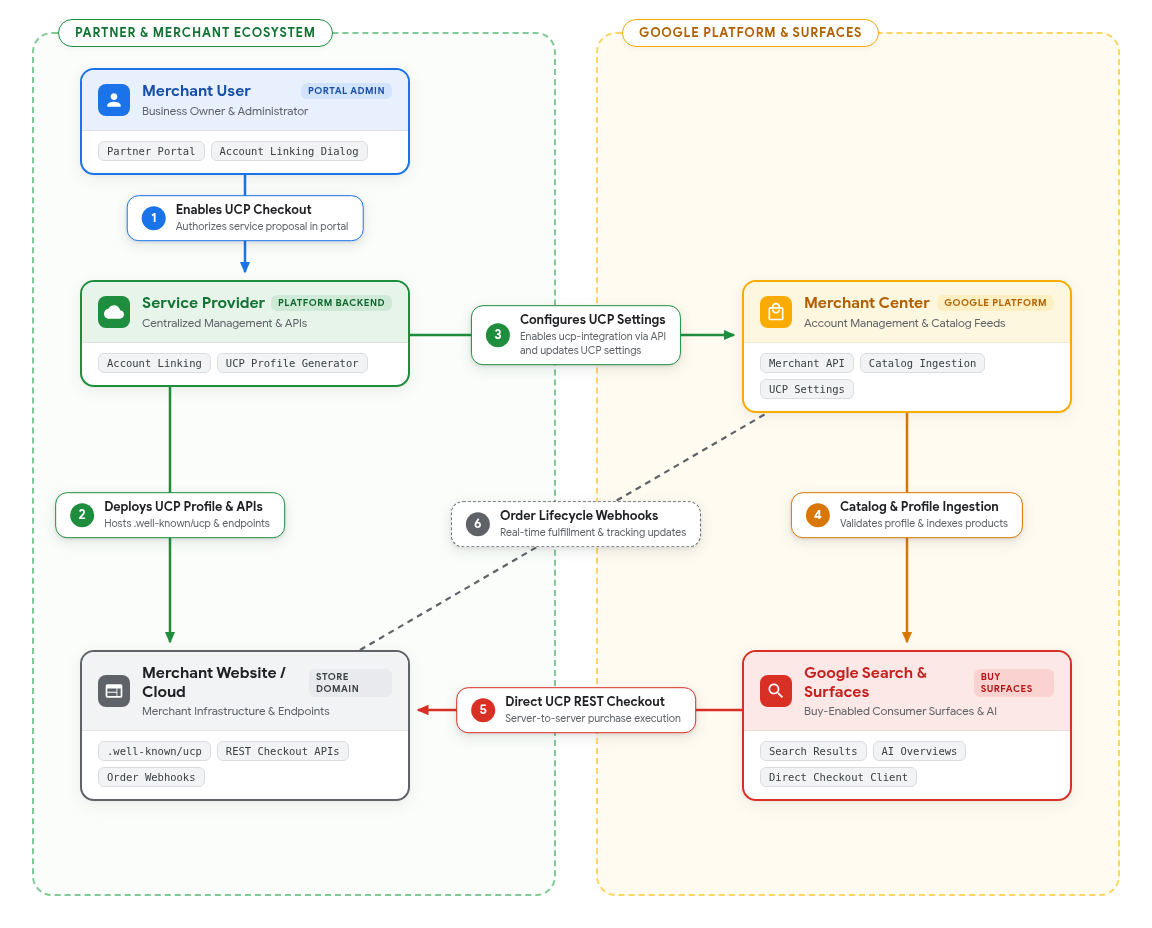
Architecture components
The integration architecture connects five key entities:
- Merchant user: The business owner or administrator who authorizes services through your platform's portal.
- Service provider: Your platform backend that coordinates account linking, manages credentials, and configures UCP settings centrally.
- Merchant website / cloud: The merchant's domain and infrastructure
hosting the public
.well-known/ucpprofile, checkout endpoints, and order webhooks. - Merchant Center: Google's platform that manages merchant accounts, service proposals, and catalog ingestion.
- Google Search: Buy-enabled surfaces where shoppers discover products and initiate checkout sessions.
Step-by-step data flow
The end-to-end integration flow operates across six sequential steps:
- Enables UCP checkout: The merchant initiates service enablement in your portal, launching the Google-hosted dialog to authorize the service proposal.
- Deploys UCP profile and APIs: Your platform generates and hosts the
merchant's
.well-known/ucpJSON profile and configures the REST checkout endpoints on the merchant domain. - Configures UCP settings: Your backend calls the Merchant API to
enable the
ucp-integrationprogram and register the merchant's profile URI. - Catalog and profile ingestion: Google validates the merchant's hosted technical profile and indexes approved catalog items.
- Direct UCP REST checkout: When a buyer purchases an item on Google Search or AI surfaces, Google coordinates transaction processing server-to-server directly against the merchant's checkout endpoints.
- Order lifecycle webhooks: The merchant backend streams real-time order status, fulfillment, and tracking updates to Google's central ingestion pipeline.
Core capabilities offered
- UCP checkout: Allows Google Search and AI surfaces to initiate, update, and finalize secure checkout sessions directly against your infrastructure.
- UCP order webhooks: Streams real-time order lifecycle events and status updates between your backend platform and Google's central ingestion pipeline.
Next steps
To begin your integration, see service provider account setup.